
Guide
Whale watching in Panama: the complete guide
Panama is one of very few places where northern and southern humpbacks both gather. When to come, what you will actually see, and how to do it without pressuring the animal.
The Gulf of Panama receives two separate humpback whale populations every year. It sounds like brochure copy and it is not: two migrations coming from opposite hemispheres meet in the same water. Very few places on earth can say that.
Why they come here
Humpbacks feed in cold water and breed in warm water. The Gulf of Panama gives them exactly what the second half needs: stable temperature, moderate depth and protected zones around the islands where a newborn calf can learn to breathe without fighting swell.
The southern group arrives from Antarctica and Patagonia between July and October. The northern group comes down from California and Alaska between December and March. The southern window is the busier one and the one we run most consistently.
What you will actually see
It is worth grounding expectations, because ninety percent of the videos that circulate are one percent of the moments.
- Blows and backs. This is how nearly every sighting starts: a column of vapour at distance, then a dark back breaking the surface.
- Fluke lifts. As the animal dives it raises its tail. It is the classic photograph and the most common of the good ones.
- Mothers with calves. In peak season it is common to see them moving slowly through shallow water.
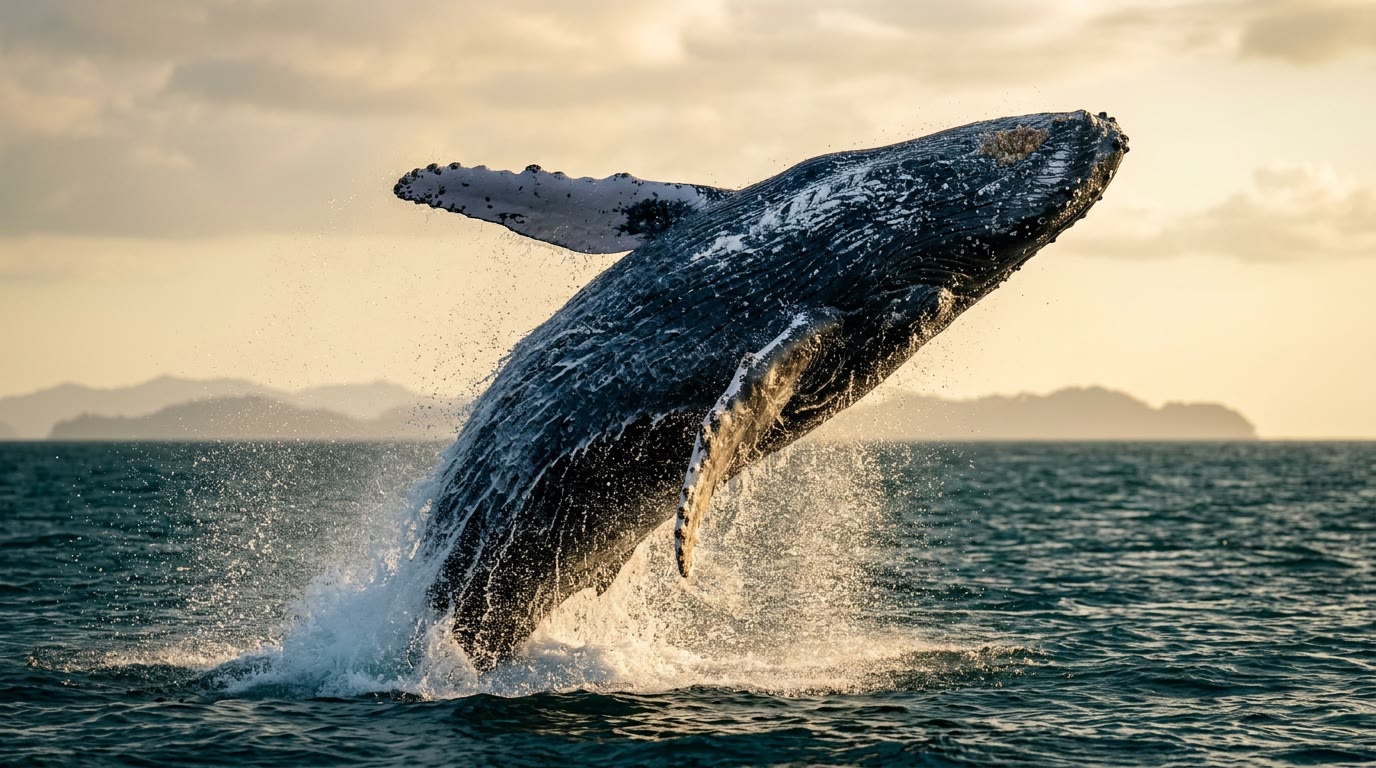
- Full breaches. The most spectacular and the least predictable. It happens, but nobody can promise it.
- Dolphins and turtles. They show up on nearly every trip, even when the whales decide not to perform.
How responsible watching works
This is not a conscience footnote, it decides whether the animal stays or leaves, and whether the experience is good or merely loud. The rules we follow:
- Always approach from the side, never head on and never cutting across their course.
- Hold the minimum distance Panamanian rules require.
- Reduce or cut engine if the animal approaches on its own.
- Never chase a mother with a calf.
- Cap the time spent with any one group of whales so pressure does not accumulate.
If a boat offers to get you closer than everyone else, it is offering to break the rule that protects the animal, and you along with it.
What to bring
Sunscreen and a cap, obviously. But what people thank us for most is a pair of polarized sunglasses: they cut the glare and let you see under the surface, which is where half the story happens. Bring a light layer for the wind while running and a camera with a full battery.
If you get seasick easily, take something the night before, not at the dock. The open gulf moves more than the bay.
How we build the day
The full day whale trip leaves early, searches the water reported most active that week, and slows down midday with an island anchorage to swim and eat. That design is deliberate: if the whales do not show, the day is still a good day on the water. A whale trip that only works when it works is a bad product.
Outside the July to October window we do not sell this as a whale watch, because the odds drop too far. In those months the honest route is fishing the Pearl Islands, and if a whale turns up, all the better.